
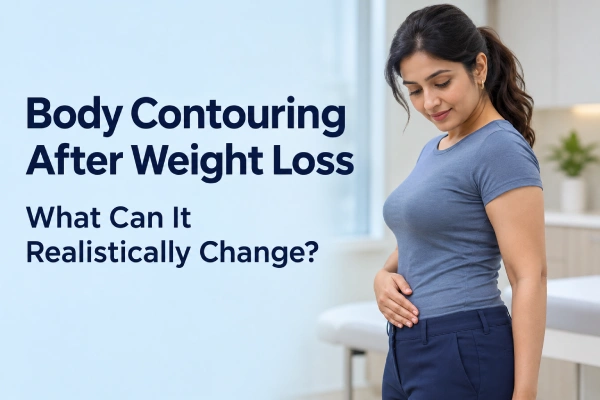
You've put in months of effort. The scale has moved, your clothes fit better, and your energy is up. But when you look in the mirror, a few areas haven't kept pace. Perhaps it's your lower belly, your love handles, your upper arms, or skin that feels softer than it used to.
This is a question patients bring to us after successful weight loss. Would body contouring help with the area that still bothers them? The answer depends partly on what they're seeing. A pocket of fat, a change in muscle definition and a fold of loose skin can each call for a different approach.
Why does stubborn fat stay after weight loss?
Your body doesn't lose fat evenly. Where you lose it first, and where it stays longest, depends on factors including genetics, age, sex, hormones, your starting fat distribution and how much weight you've lost. That's why two people who lose the same number of kilos can end up with very different shapes.
For many people, the lower abdomen, flanks, inner thighs and upper arms are among the last areas to change. Pockets of fat can remain even when your overall body fat is in a healthy range.
Skin plays a part too. When fat volume shrinks, skin doesn't always tighten at the same pace, especially after substantial weight loss or as skin loses elasticity with age. If loose skin is your main concern, reducing fat in that area may do little to address it.
What is non-surgical body contouring?
Non-surgical body contouring is a group of in-clinic treatments that use an external device to change the appearance of a specific area without incisions. Depending on the device, the aim may be to reduce a small pocket of fat, improve the appearance of cellulite, firm the skin or improve muscle tone.
Body contouring does not produce meaningful weight loss. If your main goal is to lose weight, good nutrition, regular activity and, where appropriate, a medical weight-management programme are more relevant to that goal.
How do the main technologies work?
Cryolipolysis (fat freezing). A device applies controlled cooling to a small area of fat beneath the skin. Over the following weeks to months, the body gradually clears damaged fat cells. The aim is a modest reduction in the treated bulge.
Heat-based treatments (radiofrequency and certain lasers). These devices deliver heat at different depths. Some target localised fat. Others can temporarily improve the appearance of cellulite or stimulate collagen, which may modestly improve skin firmness. The expected benefit depends on the particular device.
Electromagnetic muscle stimulation. A magnetic field triggers repeated muscle contractions in the treated area, such as the abdomen or buttocks. The goal is improved muscle tone or definition. Maintenance treatments may be needed.
Studies of fat-reduction devices have reported changes in fat thickness or circumference at the treatment site. The improvement is generally modest. A useful question for your consultation is, “What change could I reasonably expect to see in this particular area?”
Who is a good candidate for body contouring?
It may be worth discussing treatment with a doctor when:
- You're at or close to a weight you expect to maintain.
- Your weight has been stable for several months.
- You can identify a specific area you'd like to change.
- A subtle improvement would feel worthwhile to you.
- Your doctor has assessed the area, reviewed your medical history and confirmed that the proposed device is suitable for you.
Still losing weight? Here's why it's worth waiting
If you still have a fair amount of weight to lose, your overall plan should stay the priority. Your shape keeps changing as you lose weight, so an area that bothers you today may look quite different in three months. Once your weight has settled, you and your doctor can better judge what remains and whether treating it would make a noticeable difference.
Can body contouring fix loose skin after weight loss?
Some heat-based devices may modestly improve firmness when skin laxity is mild. A fold of hanging skin is a different concern. Non-invasive devices can't remove that excess tissue.
If you have significant loose skin after losing a large amount of weight, a consultation with a plastic surgeon can help you understand what surgical removal would involve. It's worth clarifying this distinction before committing to a course of sessions.
Can body contouring replace exercise?
No. Regular activity supports heart health, strength and mobility. Strength training can also help you retain muscle as you lose weight. A device that stimulates one muscle group or treats a small area of fat can't provide the broader benefits of regular exercise.
Is body contouring safe? Side effects and who should avoid it
Each technology has its own risks. Temporary effects can include redness, swelling, bruising, tenderness or numbness in the treated area. Heat-based devices can also cause burns.
One uncommon complication of fat freezing is paradoxical adipose hyperplasia (PAH). A firm bulge develops in the treated area months after treatment and grows instead of shrinking. It may require surgery to correct. If you notice this change, contact your treating clinician.
Before booking, tell your doctor if you:
- Have a pacemaker or another implanted electronic device.
- Have metal implants, surgical scars or a known hernia in or near the proposed treatment area.
- Are pregnant or breastfeeding.
- Have a cold-sensitive condition and are considering fat freezing.
- Have an ongoing medical condition or take medication that may affect treatment.
Your doctor should check these details against the safety instructions for the specific device and treatment site.
What results can you realistically expect?
Your results depend on the technology, the area treated and how your body responds. Changes often appear gradually over several weeks or months. Some people are satisfied after one session. Others may need a series or see little visible change.
Before you start, ask your doctor what improvement is realistic, how many sessions they expect to recommend, and when you should review the result together.
Frequently asked questions
Can body contouring help me lose weight?
No. It can change the contour of a treated area, but you shouldn't expect a meaningful change on the scale.
Should I lose weight before body contouring?
If you still have significant weight to lose, it usually makes sense to focus on that first. Once your weight has been stable for a few months, it's easier to assess the area you want to treat.
Can non-surgical treatments remove loose skin after weight loss?
Some devices may mildly improve skin firmness. Removing a substantial fold of excess skin requires a surgical assessment.
How many body contouring sessions will I need?
It depends on the device, the size of the area and your goals. Your doctor can give you an estimate after examining the area.
Is body contouring permanent?
Some changes can last, but gaining weight can alter the contour again. Improvements in muscle tone, skin firmness or cellulite may fade and may require maintenance sessions.
What's the difference between body contouring and liposuction?
Liposuction is a surgical form of body contouring that removes fat through suction. The non-surgical treatments discussed here use devices outside the body and involve no incisions. Temporary discomfort or swelling can still occur.
How we approach body contouring at VeCura Wellness
At VeCura, body contouring is one part of a broader weight-management and body-composition plan. We start by asking what you'd like to change. Then we review your weight history, how stable your weight has been, your body composition analysis and your medical history.
That assessment helps us explain whether contouring makes sense, which technology suits the area you're concerned about, or whether something else should come first.
Wondering whether you're ready for body contouring? Book a consultation with our doctors to find out.