

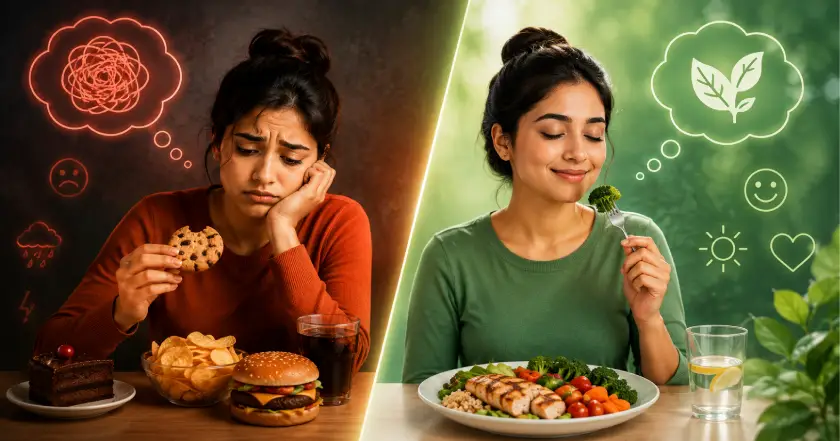
Have you ever reached for a biscuit or a packet of chips when you were not actually hungry? Learning to separate emotional hunger from physical hunger is one of the most useful skills in long-term weight management, because the two feel similar in the moment but need completely different responses.
One needs food. The other needs something else entirely.
Most of us eat in response to stress, boredom, sadness, tiredness or celebration at some point. That is ordinary human behaviour, not a character flaw. What matters clinically is how often it happens, how much control you feel you have, and whether it is quietly working against your health goals.
What Is Physical Hunger?
Physical hunger, sometimes called homeostatic hunger, is your body signalling a genuine need for energy. It is driven by hormonal and neural signals, including ghrelin from the stomach and leptin from fat tissue, acting on the hypothalamus.
Physical hunger typically:
- Builds up gradually over hours rather than appearing all at once.
- Is felt in the body, such as an empty stomach, low energy, poor concentration and sometimes irritability.
- Is open to many foods. If you are truly hungry, idli or dal will do the job.
- Settles once you have eaten enough, and you can usually stop when comfortably full.
- Is not normally followed by guilt.
What Is Emotional Hunger?
Emotional hunger is driven by mood, habit and reward rather than by an energy deficit. It is closer to what researchers call hedonic or reward-driven eating: the brain's dopamine reward circuitry making a particular food feel urgently desirable.
Emotional hunger typically:
- Arrives suddenly, often within minutes of a trigger.
- Demands one specific thing, usually something sweet, fried or high in fat and sugar. A bowl of vegetables will not satisfy it.
- Is not switched off by a full stomach.
- Often happens on autopilot, in front of a screen or phone.
- May be followed by regret, although this varies considerably between people.
Important: These are patterns, not a diagnostic test. Real eating episodes are often mixed. Arriving home genuinely hungry after a long, stressful day and then eating far past fullness can involve both physical and emotional hunger.
Emotional Hunger vs Physical Hunger: A Quick Comparison
| Feature | Physical Hunger | Emotional Hunger |
|---|---|---|
| Onset | Gradual and builds over hours | Sudden, often minutes after a trigger |
| Food choice | Flexible — most foods appeal | Specific — usually sweet, fried or salty |
| Where you feel it | In the stomach and body | In the mind, as an urge or thought |
| Effect of fullness | Hunger settles once satisfied | The urge can persist past fullness |
| Awareness | Usually deliberate eating | Often distracted or automatic |
| Afterwards | Satisfaction | Sometimes regret or self-criticism |
Why Does Stress Increase Cravings?
Stress does not affect appetite in one single direction, and this is where popular advice often gets it wrong.
Acute Stress
Acute, short-lived stress often suppresses appetite. Adrenaline and the sympathetic nervous system divert the body away from digestion, which is why many people cannot eat before an exam or a difficult meeting.
Chronic Stress
Chronic, ongoing stress tends to have the opposite effect. Sustained activation of the hypothalamic-pituitary-adrenal axis keeps cortisol elevated.
Elevated cortisol has been linked to increased appetite and a stronger preference for energy-dense foods high in sugar and fat, partly by amplifying reward-related brain pathways.
These foods can produce short-term relief, which reinforces the habit loop. The relief teaches the brain to repeat the behaviour the next time stress appears.
Individual responses also differ. Cortisol reactivity varies between people, and some individuals eat less rather than more under stress. This is one reason a template diet plan works poorly for stress-driven eating, while an individual assessment works better.
The Overlooked Factor: Sleep
Short sleep changes appetite hormones measurably. In a controlled crossover study involving healthy young men, two nights of restricted sleep lowered leptin, the satiety hormone, raised ghrelin, the hunger hormone, and increased both self-reported hunger and appetite.
The strongest pull was towards calorie-dense, carbohydrate-rich foods.
In practice, an evening of relentless snacking may have started as a sleep problem the previous night, not a willpower problem that day. If your eating pattern has changed recently, sleep is one of the first things worth reviewing.
Other Things That Masquerade as Hunger
- Habit and cues: The 4 p.m. tea trolley, the interval at the cinema, or driving past a familiar bakery. Cue-driven eating is learned, and it can be unlearned.
- Under-built meals: Meals low in protein and fibre empty quickly and leave you hungry sooner. This is genuine physical hunger created by the composition of the previous meal.
- Long gaps between meals: Very delayed eating tends to produce intense hunger that is much harder to regulate.
- Alcohol: Alcohol lowers inhibition and can independently stimulate appetite.
- Medication and medical causes: Steroids, some antidepressants and antipsychotics, uncontrolled diabetes and thyroid disorders can alter appetite. These concerns should be discussed with your doctor rather than assumed to be behavioural.
Practical Steps That Actually Help
-
Pause and name it. Before eating, ask whether you would be equally happy with a plain, everyday food. If only one specific item will do, the drive is more likely emotional than physical.
-
Eat without a screen. Distracted eating consistently increases how much is eaten in a sitting and weakens the memory of the meal, which can affect the next one.
-
Build meals that hold. Adequate protein and fibre at each main meal reduce hunger between meals more effectively than restricting portions alone.
-
Keep meal timing reasonably regular. Long, unplanned gaps tend to be followed by overshooting.
-
Have a glass of water and wait ten minutes. This is not because thirst is commonly mistaken for hunger, as that claim is not well supported in humans. A deliberate ten-minute delay can help break the automatic loop.
Separately, a pre-meal glass of water has been shown in trials to modestly reduce intake, most consistently in middle-aged and older adults.
-
Protect your sleep. Aim for a consistent sleep window rather than focusing only on a target number of hours.
-
Move briefly. A short, brisk walk is a well-tolerated way to lower acute stress, and it fills the ten minutes during which the urge may be strongest.
-
Address the stressor itself, not just the craving. Breathing exercises, a proper conversation with someone you trust, or professional support can treat the cause. Food treats the symptom only briefly.
-
Do not ban your favourite foods. Rigid restriction predicts stronger cravings and rebound eating. Planned, unhurried enjoyment is more sustainable than complete avoidance.
When Emotional Eating Needs More Than Self-Help
Occasional emotional eating is common and is not a disorder. It is worth speaking to a doctor if you notice:
- Episodes where you feel a real loss of control over how much you are eating, recurring most weeks over a few months.
- Eating in secret, or experiencing significant distress, shame or low mood around eating.
- Any behaviour aimed at compensating for what you have eaten.
- Eating that is clearly interfering with your health, work or relationships.
These symptoms can indicate binge eating disorder or another eating disorder. Both are common, treatable and considerably more responsive to proper treatment than to willpower.
Raising the issue with your consultant is a clinical step, not a confession.
How We Support You at VeCura Wellness
Emotional eating is a behavioural pattern, so we assess it rather than assume it.
During your consultation, we review your eating patterns and triggers, daily routine, meal timing, sleep, stress levels, medication and relevant medical history.
We also conduct an objective body composition analysis so that your progress is tracked using more than the weighing scale.
From there, our medical officers and dietitians co-create a personalised weight loss programme with you. Your programme may include:
- Dietitian-led nutrition support built around your actual routine.
- A small number of realistic habit changes introduced at a manageable pace.
- Medically supervised appetite management, where clinically appropriate and only after a complete assessment.
The plan is personalised to you and reviewed as you progress.
Ready to understand your own hunger patterns? Book a consultation at your nearest VeCura clinic.
Doctor's Tip
Before you reach for a snack, pause and ask: “Am I physically hungry, or am I trying to change how I feel?”
Both are valid answers. Only one of them is solved by food.
Frequently Asked Questions
Is emotional eating normal?
Yes. Eating in response to emotion is extremely common and is not in itself a disorder. It becomes a clinical concern when it is frequent, feels out of your control, or is causing distress — at which point it is worth assessing properly rather than managing alone.
How do I know if I am actually hungry?
Use the plain-food test. Ask whether an ordinary, unexciting meal would satisfy you right now. If yes, that is usually physical hunger. If only one specific food will do, the drive is more likely emotional.
Also check where you feel it — physical hunger registers in the body, while emotional hunger tends to register as a thought or an urge.
Why do I crave sweets when I am stressed?
Ongoing stress keeps cortisol elevated, which is associated with greater appetite and a stronger pull towards sugary, fatty food, partly by amplifying the brain's reward response.
Those foods deliver quick relief, so the pattern gets reinforced each time. Identifying the trigger, delaying ten minutes, or changing what you are doing will often let the urge pass. If cravings are persistent, discuss them with your consultant.
Can skipping meals make emotional eating worse?
Yes. Long gaps generally produce stronger hunger later in the day and make regulating intake harder, which is why erratic eating and evening overeating so often travel together.
Should I completely avoid my favourite foods?
No. Strict restriction tends to intensify cravings and increase the chance of rebound eating. Including foods you enjoy in a planned, unhurried way is more sustainable than trying to eliminate them.
Does drinking water really stop hunger?
Partly. The idea that we routinely confuse thirst with hunger is not well supported by human studies.
However, drinking water before a meal has been shown to modestly reduce how much is eaten, most reliably in middle-aged and older adults, and the pause itself is useful.
Does weight loss medication stop emotional eating?
Appetite-regulating medication, where clinically appropriate and prescribed after full assessment, reduces physical hunger and can reduce food-related preoccupation.
It does not by itself resolve the emotional trigger or the learned habit, which is why medication is used alongside behavioural and dietary support, never instead of it.
A Final Thought
Successful weight management is as much about understanding your habits as understanding your body.
Learning to tell emotional hunger from physical hunger will not remove cravings, but it gives you a moment of choice before you act — and over months, those moments are what change the pattern.
This article is for general education and does not replace individual medical advice. If you have concerns about your eating or weight, please consult a qualified clinician.
Scientific Correction Log
Each row below describes a claim in the original draft that was inaccurate, unsupported or clinically incomplete.
| Original Claim | Problem | How It Was Handled |
|---|---|---|
| “Stress can increase appetite and cravings for high-calorie foods.” | Presented as universal. Acute stress commonly suppresses appetite through sympathetic activation. Chronic stress and sustained cortisol elevation are more likely to increase appetite. Individual cortisol reactivity also varies. | Split into acute and chronic stress. The HPA axis, cortisol and reward pathways were explained, and individual variation was acknowledged. |
| “[Physical hunger] is a joyful eating experience and doesn't make you feel bad after.” | This is not a physiological feature of hunger and is not measurable. Emotional language was being used instead of a clinical descriptor. | Replaced with defined features including gradual onset, bodily location, food flexibility and resolution with satiety. |
| Emotional hunger “is usually mindless and frantic eating, often followed by feelings of regret and guilt.” | Overstated and moralising. Guilt is variable, not definitional, and framing it as expected can reinforce shame. | Softened to “may be followed by regret, although this varies,” with a note that real eating episodes are frequently mixed rather than only one type. |
| “Hydrate first because thirst is easily mistaken for hunger.” | Widely repeated but poorly evidenced in humans. Pre-meal water may modestly reduce intake, particularly in middle-aged and older adults, but the mechanism is not necessarily thirst-hunger confusion. | The claim was corrected. The evidence-appropriate explanation was retained, while the useful ten-minute pause was presented as a way to interrupt automatic eating. |
| “Is emotional eating normal? Yes, absolutely. Practically everyone...” | Reassuring but clinically incomplete. Frequent loss-of-control eating may indicate binge eating disorder, which is common, under-recognised and treatable. | Reassurance was retained, with a new red-flag section and a calibrated FAQ answer directing readers towards assessment when appropriate. |
| No mention of sleep. | Sleep restriction is a well-evidenced, modifiable driver of appetite and is directly relevant to evening overeating. | A new section was added explaining changes in leptin, ghrelin, hunger and appetite following sleep restriction. |
| No mention of non-emotional causes that can resemble hunger. | Low-protein meals, long gaps, alcohol, medications and endocrine causes of increased appetite were absent, creating a false emotional-versus-physical binary. | A new section was added covering meal composition, meal timing, alcohol, medication and medical causes. |
| No mention of appetite-regulating medication. | This is relevant to readers considering medically supervised weight-management programmes and to the misconception that medication resolves emotional eating. | An FAQ was added explaining that medication can reduce physical hunger but does not independently resolve emotional triggers or learned habits. |
| Language and copy errors. | Errors included incorrect apostrophe use, singular and plural inconsistencies, double spaces, unsuitable hyphens and stray formatting symbols. | Grammar, punctuation, spacing and formatting were corrected throughout the article. |
References
Verify each citation against PubMed before publication and add the appropriate DOI and PubMed link.
- Adam TC, Epel ES. Stress, eating and the reward system. Physiology & Behavior. 2007;91(4):449-458.
- Dallman MF, et al. Chronic stress and obesity: a new view of comfort food. Proceedings of the National Academy of Sciences of the United States of America. 2003;100(20):11696-11701.
- Spiegel K, Tasali E, Penev P, Van Cauter E. Brief communication: sleep curtailment in healthy young men is associated with decreased leptin levels, elevated ghrelin levels, and increased hunger and appetite. Annals of Internal Medicine. 2004;141(11):846-850.
- Taheri S, Lin L, Austin D, Young T, Mignot E. Short sleep duration is associated with reduced leptin, elevated ghrelin, and increased body mass index. PLoS Medicine. 2004;1(3):e62.
- Dennis EA, et al. Water consumption increases weight loss during a hypocaloric diet intervention in middle-aged and older adults. Obesity. 2010;18(2):300-307.
- Macht M. How emotions affect eating: a five-way model. Appetite. 2008;50(1):1-11.
- Robinson E, et al. Eating attentively: a systematic review and meta-analysis of the effect of food intake memory and awareness on eating. American Journal of Clinical Nutrition. 2013;97(4):728-742.
- American Psychiatric Association. Diagnostic and Statistical Manual of Mental Disorders, Fifth Edition, Text Revision. Binge eating disorder criteria. 2022.
Editorial note: The water-consumption study is population-specific. Its findings should not be generalised to younger adults without appropriate supporting evidence.