

Medically reviewed by Dr. Shajitha Nisha, MBBS, Medical Officer, VeCura Wellness.
Almost everyone who has ever wanted to lose weight has tried it: hundreds of crunches to flatten the belly, endless arm exercises to shrink "bat wings," or squats aimed squarely at the thighs. The logic feels obvious. Work the muscle under the fat, and the fat on top should disappear. It is one of the most common beliefs in fitness, and one of the most persistent.
It is also, when it comes to exercise alone, a myth.
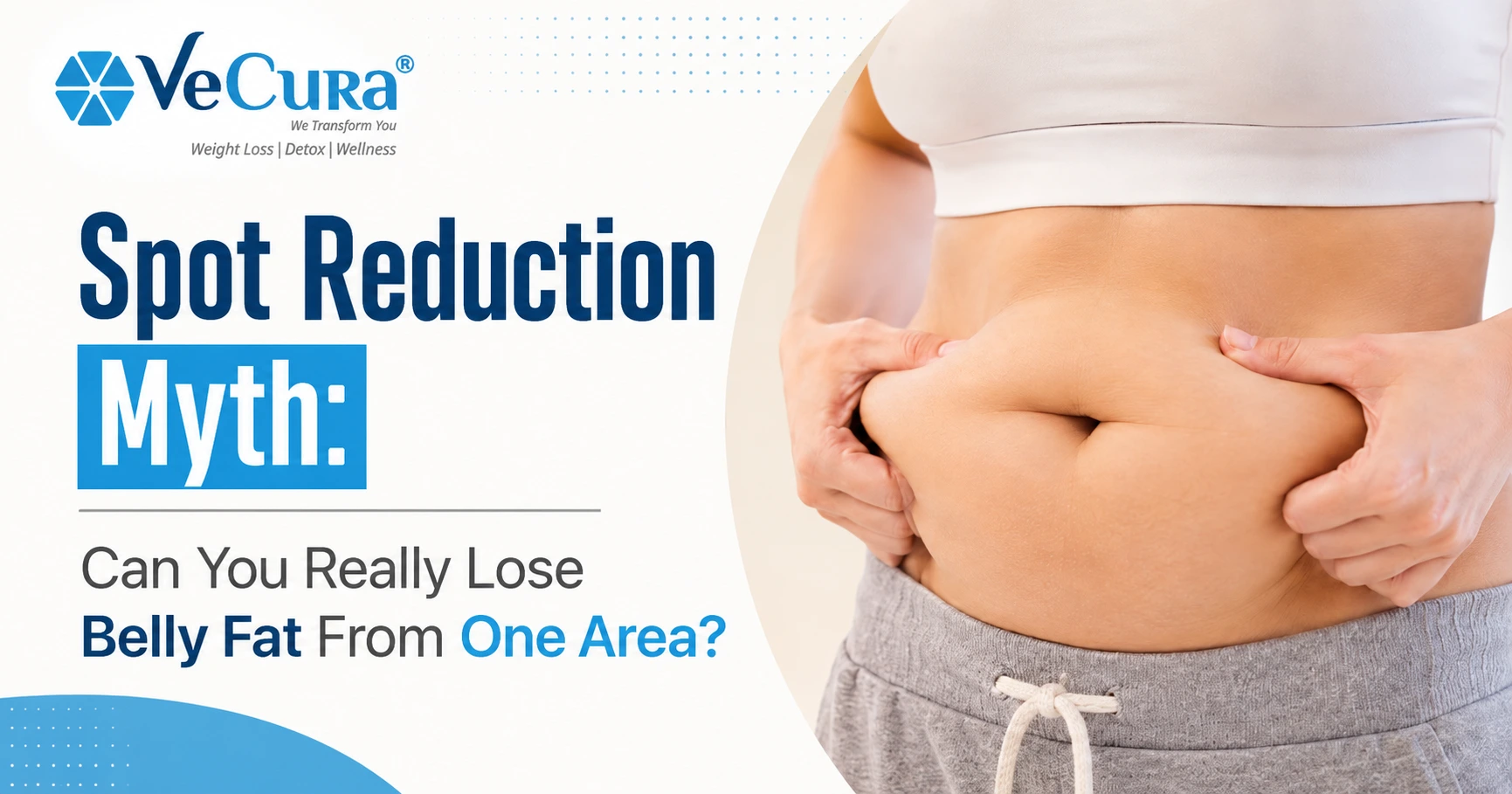
This idea is called spot reduction, the belief that you can burn fat from one specific part of your body by exercising that area. At VeCura Wellness, our doctors hear this question almost daily: "Can I just lose fat from my stomach?" or "Which exercise removes double chin?" The honest, science-backed answer is nuanced, and understanding it can save you months of frustration. So let's separate what your body genuinely can and cannot do, and where modern, doctor-led treatments fit in.
What "spot reduction" actually means
Spot reduction is the assumption that targeted muscle activity burns the fat sitting directly above that muscle. Do crunches, lose belly fat. Do arm curls, lose arm fat. It sounds reasonable, and the fitness industry has sold this promise for decades through ab gadgets, vibrating belts, and "fat-burning" workout DVDs.
The problem is that this isn't how human fat metabolism works. When your body burns fat for energy, it does not draw exclusively from the muscle you happen to be exercising. It draws from fat stores across your entire body, in a pattern largely written into your genes.
The science: why exercise can't target one area
To use stored fat for fuel, your body has to go through a process called lipolysis, breaking down fat (triglycerides) inside fat cells and releasing it into the bloodstream, where it travels to wherever energy is needed. The key word is bloodstream. Fat released from your stomach can power your shoulders during a workout, and fat from your thighs can fuel your abs. There is no private pipeline connecting the muscle you're training to the fat cells immediately above it.
This is why a person doing 500 crunches a day can build genuinely strong abdominal muscles and still see no change in their belly. The muscle gets stronger underneath, but the fat layer on top stays put. The crunches burn calories, yes, but the fat lost comes from all over the body, distributed in whatever pattern your genetics dictate.
Researchers have tested this directly. In controlled studies, participants trained one specific limb intensively for weeks while the other rested. When measured afterward, the trained limb showed no greater fat loss than the untrained one. The muscle had changed; the local fat had not. A large review of the evidence reached the same conclusion: localised muscle training does not reduce fat in the localised area. The takeaway across decades of research is consistent: you cannot choose where your body loses fat through exercise.
So how does fat loss really happen?
Fat loss is a whole-body event, and it is driven by one core principle: a calorie deficit. When you consistently consume fewer calories than your body uses, your body taps into stored fat for energy, and you lose fat gradually, and from everywhere at once.
Where you lose it first is the part you don't control. This is determined by genetics, hormones, age, and gender. Some people lose from their face and arms quickly but hold onto belly or thigh fat stubbornly. Others are the reverse. This is also why the last bit of fat, the lower belly, the love handles, the inner thighs, the area under the chin, is so frustrating. These are typically the regions where your body prefers to store fat and is most reluctant to release it.
This brings us to an important distinction we make at VeCura: fat loss is not the same as weight loss. Weight loss means losing overall body mass, which can include water and muscle alongside fat. Fat loss means specifically reducing stored fat while protecting muscle, which is what actually changes how your body looks and feels. A good weight management program is built around fat loss, not just a falling number on the scale.
The honest truth about "stubborn" fat
Here is where many people get stuck. You eat well. You exercise. The scale moves. And yet that one area, the lower abdomen after pregnancy, the double chin that photographs badly, the upper arms, barely changes. You are doing everything right, and it still won't budge.
You are not imagining it. Certain fat deposits are genuinely more resistant to diet and exercise because of how their fat cells respond to the hormones that trigger fat breakdown. These pockets often remain even when someone is otherwise close to their ideal weight. No amount of targeted exercise will preferentially remove them, because, as we've established, targeted exercise doesn't remove fat from a chosen spot in the first place.
This is the real reason the spot-reduction myth is so damaging. It convinces people that their lack of results is a personal failing, when in fact they've simply been using a tool (localised exercise) that was never capable of doing the job.
Where targeted fat reduction is real, under medical care
Now for the part that surprises people. While you cannot spot-reduce through exercise, targeted fat reduction is genuinely possible through clinical, non-surgical treatments. This is the crucial difference between a gym myth and a medical reality.
Treatments such as cryolipolysis (fat freezing) and CoolSculpting work on a completely different mechanism than exercise. Instead of asking the body to mobilise fat from everywhere, these technologies act directly and only on the fat cells in a specific, treated area. Cryolipolysis cools targeted fat cells to a temperature that destroys them while leaving skin, nerves, and muscle unharmed. Over the following weeks, the body naturally clears away these destroyed cells through its own metabolic processes. Because the fat cells in that pocket are gone, they don't return, though maintaining a stable, healthy lifestyle is still essential to keep new fat from accumulating elsewhere.
Other doctor-administered options, like injectable lipolysis, similarly break down fat cells in defined zones such as the double chin or stubborn belly. These are the treatments behind VeCura's concern-based approach, focused protocols for belly, thighs, arms, calves, neck, chin, and more, and they are precisely the tool that exercise can never be: area-specific.
A vital caveat keeps this honest: these are body-contouring treatments, not weight-loss solutions. They are not designed to help someone lose 20 kilos. They are designed for people who are already close to their goal weight but are left with stubborn, localised pockets that refuse to respond to diet and exercise. Used that way, as the finishing touch rather than the whole strategy, targeted fat reduction is one of the few legitimate ways to "spot reduce."
The VeCura approach: measure first, then target
Because where you carry fat, how much is fat versus muscle, and which areas are realistically treatable all vary from person to person, guesswork is the enemy. This is why every VeCura journey begins with a Body Composition Analysis (BCA) rather than a treatment.
The BCA shows your doctor exactly how much body fat you carry, your muscle mass, and your metabolic picture. From there, a doctor builds a personalised plan that combines the right approach for your situation, sustainable fat loss through nutrition and lifestyle for overall reduction, and where appropriate, targeted non-surgical treatments for the stubborn areas that diet alone won't fix. Progress is then tracked with real measurements: fat percentage, centimetres lost, and muscle preserved. No guesswork, no empty promises about doing crunches to lose belly fat.
The bottom line
So, is spot reduction a myth? When it comes to exercise: yes. You cannot do crunches to melt belly fat, or arm exercises to erase arm fat. Fat loss happens across your whole body, governed by a calorie deficit and your own genetics, and you don't get to pick the order.
But the full truth is more encouraging than the myth. Overall fat loss is absolutely within your control through consistent, sustainable habits, and for those last stubborn pockets that simply won't respond, medically supervised, targeted fat reduction is a real, science-backed option. The mistake isn't wanting to slim a specific area. The mistake is trying to do it with a method that was never built for the job.
If stubborn fat has left you frustrated despite doing everything right, the smartest first step isn't another exercise routine. It's understanding your body. Book a Body Composition Analysis with VeCura Wellness, and let a doctor show you exactly what's treatable, what's realistic, and how to finally target the areas that have resisted everything else.
Frequently asked questions
Can you lose belly fat by doing crunches?
No. Crunches strengthen your abdominal muscles but do not burn the fat over them. Fat loss is systemic, so your body draws from fat stores across the whole body based on a calorie deficit, not from the area you exercise.
Is spot reduction possible at all?
Not through exercise. But targeted fat reduction is possible through clinical, non-surgical treatments such as cryolipolysis and CoolSculpting, which act only on fat cells in a specific treated area.
How does the body actually lose fat?
Through a calorie deficit. When you use more energy than you consume, your body breaks down stored fat and releases it into the bloodstream from fat stores all over the body. Genetics and hormones decide where you lose it first.
What is the difference between fat loss and weight loss?
Weight loss means losing overall body mass, which can include water and muscle. Fat loss means reducing stored fat while preserving muscle, which is what changes how your body looks and feels.
How long does it take to see fat loss results?
With a consistent calorie deficit and exercise, most people notice changes within about 8 to 12 weeks. Stubborn areas usually respond last, and some localised pockets may need non-surgical treatment.
References
- Vispute SS, Smith JD, LeCheminant JD, Hurley KS. The effect of abdominal exercise on abdominal fat. Journal of Strength and Conditioning Research. 2011.
- Kostek MA, Pescatello LS, Seip RL, et al. Subcutaneous fat alterations resulting from an upper-body resistance training program. Medicine & Science in Sports & Exercise. 2007.
- Ramirez-Campillo R, Andrade DC, Campos-Jara C, et al. Regional fat changes induced by localized muscle endurance resistance training. Journal of Strength and Conditioning Research. 2013.
- Fuller N. Spot reduction: why targeting weight loss to a specific area is a myth. University of Sydney. Available at: sydney.edu.au
- Can You Target Fat Loss to Specific Body Parts? GoodRx Health. Available at: goodrx.com
This article is for general education and is not a substitute for personalised medical advice. Treatment suitability and results vary by individual and should be assessed by a qualified doctor during consultation.